Wednesday, July 8, 2015

Campfires Currently Prohibited


Do to the extremely dry conditions campfires are currently prohibited in the King Range National Conservation Area outside of developed recreation sites: Mattole, Honeydew, Wailaki, Nadelos, Horse Mountain, and Tolkan campgrounds.

It is very DRY and often very windy.
Even if it’s foggy the vegetation is still very dry. Also, conditions change frequently and rapidly here on the coast. I very often see the weather change from calm and foggy to hot and windy in an hour or less.

If you are backpacking in the King Range Campfires are prohibited  

If you see a fire ring such as this:


This does not mean you are permitted to have a campfire. The Bureau of Land Management did not build these rings. We maintain and dismantle these fire rings but never build them.

Every year since I’ve been here we have had an escaped campfire or fire started from a camp stove.

Use extreme caution with camp stoves – be well away from dry grasses.

The instructions for the Whisperlite stove Mountain Safety Research says to, “keep combustibles 4 feet away from all sides.” MORE than 4 feet would be a VERY good idea, especially in the extremely dry and windy conditions of the Lost Coast.

The NorthCoast Journal published an article on February of 2013 by a backpacker who accidentally started a fire on the Lost Coast. The article is well written, eye-opening and very educational. Here is an excerpt:

“Right then, a gust of wind hit, and this ball of flame took on a life of its own, jumping maybe 10 feet to my right and landing on a steep bank of dry grass. In seconds, the entire hillside was a crackling wall of fire. And that's all it took. It was out of control.”


Also in the North Coast Journal:

Advice for Backpackers (Novice and Veteran)
BY BARRY EVANS

I started backpacking and camping when I was 13, and I'm now 70. I'm a 57-year wilderness veteran, Queen Scout (U.K. equivalent of an Eagle Scout), Sierra Club member, champion of outdoor ethics, and I don't like open wood fires (too dangerous).

So how do I explain the fact that I burned down almost a square mile of wild grassland? And what can I say that might help prevent this from happening to anyone else?

1. Think "fire." When we picked our campsite, I was thinking flat area, water, beautiful view. In my over-confidence, I barely gave a thought to what should have been my No. 1 priority: a safe area for a fire, clear of any vegetation.

2. Think "wind." The wind blows down the Lost Coast hard, which is why everyone hikes north-to-south. We'd been seduced by the previous half-hour lull, instead of assuming that the next big gust might be seconds away.

3. Think "stove safety." Hundreds of safe, non-eventful lightings of our stove led to a sense of complacency. Stoves are not foolproof. They can leak. Fuel left in the bowl does evaporate -- fast, as we found out. A Coleman-fuel stove like ours sometimes blows out in wind. If it does, it should be allowed to cool before re-lighting, to prevent flare-ups.

--------------------------------------------------------------------------------------------------------------------------
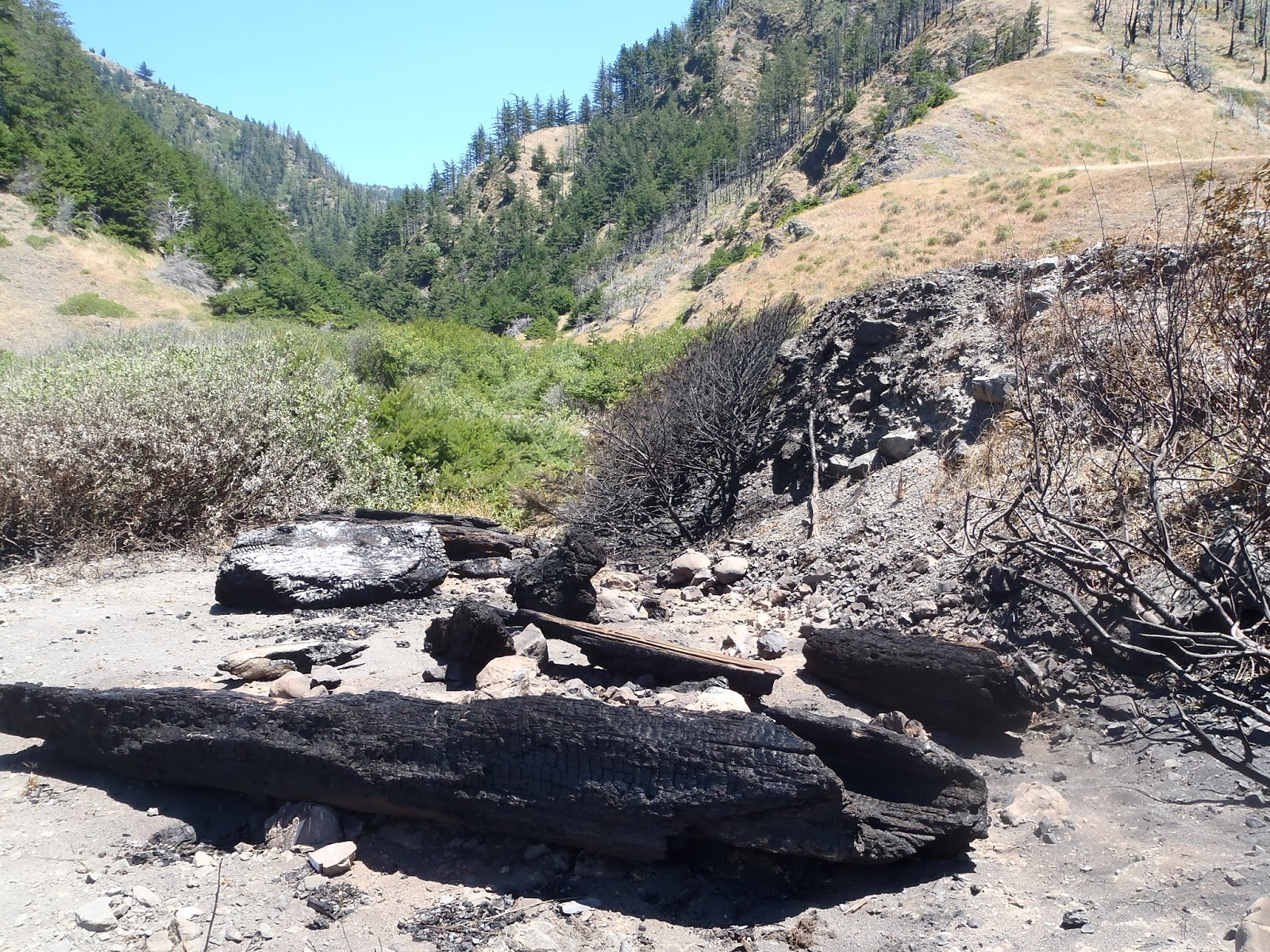
There have been many escaped campfire or fires started from camp stoves the past several years.

See pictures below of these incidences:

 Photo courtesy of Barry Evans and Louisa Rogers 
Spanish Flat, escaped camp stove

Spanish Flat, escaped campfire

Kinsey Creek, escaped campfire

Cooskie Creek, escaped campfire

Spanish Flat, escaped campfire;
The high winds threw a small ember into a large structure of driftwood, igniting it nearly instantly. 

Cooskie Creek, escaped campfire;
It was fortunate that this did not catch the adjacent hillside on fire

If you have questions don't hesitate to contact me
(give at least a few days for a response)

Your Wilderness Ranger, 

Paul
707-986-5405
lostcoastranger@gmail.com


Thursday, June 11, 2015

Fascinating Creatures of the King Range #2

This past week while out on patrol of the King Range Wilderness I witnessed quite the spectacle. What appeared to be a large fly/wasp was carrying a caterpillar underneath it as it scurried along the ground next to where I was eating lunch. It eventually reached a small hole in the ground where it dragged the caterpillar down into. The insect came back out empty handed then proceeded to shovel soil and debris into the hole to cover it up - much in the way a dog would cover it's bone.

I have no idea what this insect was so I contacted an entomologist named Eric who identified it as:

"cutworm hunter wasp in the genus Podalonia, family Sphecidae"

Eric also says of the cutworm hunter wasp:

"Cutworm wasps are named for the habit of the solitary females to hunt for soil-dwelling caterpillars (“cutworms”), paralyze them, and store them as food for the wasp’s offspring. The wasp digs her burrow after she procures the prey, which is the opposite behavior sequence of most wasps in the Sphecidae family. Only one caterpillar goes in the bottom of each burrow, and a single egg is laid upon it. The opening of the tunnel is then sealed and the wasp begins seeking another victim to repeat the process."

So There you have it! Very  fascinating.

For more about Eric and insects visit his blog at:
http://bugeric.blogspot.com/2011/06/wasp-wednesday-podalonia.html

On another note, I was at the Punta Gorda Lighthouse this past week and noticed some new graffiti and trash left from visitors.


The graffiti says, "Evarything is still good! Don't want to bring back coffee cream sugar and TP."

Not only did this individual litter but they also graffitied a historic building. Please, pack out all of your trash and leave your graffiti out of the wilderness. YOU ARE NOT DOING A PUBLIC SERVICE BY LEAVING YOUR UNUSED ITEMS (aka, littering). 

A sad sight. And yes, they spelled everything wrong. 


Wednesday, May 27, 2015

American Hiking Society and Wilderness Volunteers Visit the King Range


From May 4th-8th six individuals with the American Hiking Society, a national organization that organizes and coordinates volunteer vacations on public lands, joined me on the Lost Coast Trail to perform campsite and trail maintenance, and to restore wilderness character.

 30 campfire rings maintained (cleaned of all ash and trash, and made smaller)
 35 campfire rings destroyed (removed fire ring and rehabilitated impacts)
 4 driftwood shelters destroyed
 153 pounds of marine garbage removed
 10 pounds of visitor garbage removed
 300 feet of trail rerouted away from steep cliffs (~ 1 mile north of Big Flat Creek)
 4 piles of toilet paper buried
 1 exposed human waste buried


a) Campfire ring before
a) Campfire ring after 
b) campfire ring before 
b) campfire ring during maintenance 
b) campfire ring after maintenance 

Please, whenever possible, use existing fire rings. We ask that you use existing fire rings and keep the fire small by using only small pieces of wood that you can break by hand. This helps contain the fire in the ring and also helps to keep the campsites clean for other visitors. Larger pieces of wood tend to spread ash outside of the ring and breaks down its perimeter. In turn, this leads to an eye sore for other visitors and encourages them to build another fire ring - multiplying the impacts. 

PLEASE help your friendly ranger by keeping your campfires small (if it's not warm enough just get closer!!) and contained withing the ring. Also, this will keep the area looking natural and undamaged for other visitors. 


what used to be the monstrosity in the above photo...

Now looks like this! 

This is the most undeveloped and natural I have ever seen this site. A huge success for restoration of wilderness character. The entire section of the Lost Coast Trail that the BLM manages is within designated wilderness. Wilderness areas have very specific mandates that must be managed for: untrammeled, natural, undeveloped, and solitude or primitive and unconfined recreation, in addition they may have unique supplemental or other features. 

I admit, when I first hiked the Lost Coast Trail I thought these structures were fascinating. But, the more I learned about wilderness and Leave No Trace the more I understood that these structures are really not that great and actually a nuisance. Let me explain: 


  • Driftwood structures don’t fit with wilderness characteristics that we manage for. Section 2(c) of the 1964 Wilderness Act states that:                                                             
" A wilderness, in contrast with those areas where man and his own works dominate the landscape, is hereby recognized as an area where the earth and its community of life are untrammeled by man, where man himself is a visitor who does not remain. An area of wilderness is further defined to mean in this Act an area of undeveloped Federal land retaining its primeval character and influence, without permanent improvements or human habitation, which is protected and managed so as to preserve its natural conditions and which
(1) generally appears to have been affected primarily by the forces of nature, with the imprint
of man's work substantially unnoticeable…”

  • Leave No Trace teaches:
Leave What You Find
  1. Preserve the past: examine, but do not touch cultural or historic structures and artifacts.
  2. Leave rocks, plants and other natural objects as you find them.
  3. Avoid introducing or transporting non-native species.
  4. Do not build structures, furniture, or dig trenches.

Additionally: 

  • Wood structures are great habitat for small rodents, especially structures that bring in a new supply of food every night. The one time I stayed in an established structure I had rodents scurrying all over my gear and sometimes me! Also, keep in mind that rodents attract snakes.
  • Large structures made out of dry wood are a fire hazard. We have had numerous incidents of driftwood structures catching on fire. This poses a threat to the forest, adjacent land owners, other visitors and YOU. Heavy winds, dry and densely packed fuels and fire are a recipe for disaster. It’s pretty easy for an ember to blow into the cracks of one of a driftwood structure and turn the whole thing into a ball of flames within minutes.

Below is a picture of a driftwood structure that caught fire. A father and his son were staying in it on a windy night, a tiny ember flew off of their fire and into the cracks of the driftwood. According to them, the entire structure was engulfed with flames in only a few moments. 

It just so happened that I was camped nearby with a Leave No Trace class; One of our classmates saw the flames as he went out to the beach to brush his teeth. We spent the next 3 hours throwing bear canisters full of water onto the flames to keep it from lighting up the nearby grasses and driftwood. 

I understand that it can get very windy out on the Lost Coast..if you make a wind break I ask you to please keep it small, don’t build onto existing structures, and PLEASE restore the site to its original condition by taking the drift wood back to where you found it. It is very easy for a small wind break to turn into a scene from Gilligan’s Island or Lord of the Flies as each visitor that camps at it builds a little more in an attempt to make some kind of “improvement.” Better yet, find a way to deal with the wind without manipulating the site and degrading the wilderness. 

Now, where was I...
Hauling nearly 100 pounds of marine garbage 

The site of a development, before we restored it to a more natural condition

The site after restoration 

From April 19-25, seven individuals with Wilderness Volunteers, a non-profit organization created to organize and promote volunteer service to America's wild lands, joined me in the King Range to perform trail maintenance on Horse Mountain Creek Trail and undertake projects to restore wilderness character.

 4.2 miles of trail brushed (cut back of encroaching vegetation) 
 4.2 miles of trail logged-out (trees and branches across the trail have been removed)
 25' of galvanized metal culvert pipe removed and carried out for discard.
 2 stream crossing improvements
 726 feet of trail tread repair
 390 feet of wire fence removed; 16 t-posts and 5 wooden posts
 30 pounds of marine garbage removed from the beach
 15 pounds of abandoned property removed
 3 water bars installed

Brushing.

Brushing..

Brushing...

and more brushing! What a great crew to work with with positive attitudes the whole time!

Before
After

Removing the old culvert

.. and hauling it piece by piece 2 miles out to the trailhead

Just a small sample of the work that was accomplished by these amazing volunteers with AHS and WV for you and our public lands. 


Your Wilderness Ranger
Paul Sever
707-986-5405
lostcoastranger@gmail.com


Thursday, April 9, 2015

What's Blooming? Guest Post From The Lost Coast Interpretive Association


Wildflowers are blooming in the high elevations of the King Range. They are spectacular and so are the views! These plants love the rocky, well-drained soil that is characteristic of the King Range. One great place to find them is just down the western slope from the top of Queen Peak (about 2 miles up Paradise Ridge Road). While you’re there, don’t forget to look up! From Queen Peak you can see King Peak, Big Flat and the mountains to the east.

California blue blossom, a low growing species of Ceanothus, steals the show with its clusters of tiny dark blue flowers. Coast whitethorn, another species of Ceanothus, is just starting to show its creamy white flowers. Both shrubs are abuzz with insects busily pollinating the flowers.

Also blooming is monkeyflower with its orange blooms.

Blue witch, a relative of potatos and tomatos, has light purple flowers and yellow centers.  

Also thriving is California milkwort, a small delicate looking plant that has deep pink flowers, and yerba santa with its pale purple flowers.


For more about the Lost Coast Interpretive Association visit lostcoast.org

Friday, March 20, 2015

This Week In The King Range: Trail Conditions and Other News


Are you planning to visit the King Range this spring break? Check out this blog post for a ton of useful information.

This past week I hiked from Lightning Trailhead along the King Crest Trail to Rattlesnake Ridge Trail which I descended to Big and Miller Flats; from there I hiked out to Black Sands Beach. Although windy, it was warm and sunny most of the time. These are a few of the things I discovered:


1. Along Big Flat Creek I was lucky to see this Northwestern Salamander:


Do you see it? Look a little closer:


2. Trail Conditions: This is what you can currently expect on the trails in the King Range


  • There are lots trees down on most of the upland trails – This is what Rattlesnake Ridge Trail looks like in several sections:


It is passable on foot but makes travel more difficult at times.


  • The lower portion of Rattlesnake Ridge Trail, where is meanders along Big Flat Creek, can be hard to follow at times. The trail crosses the creek 4 times - Keep an eye out for cairns on each side of the creek crossings to help you find the trail.

FYI - the photo above is not current. I'm including it here to show you what a cairn looks like so you know what to look for. Also, please do not build additional cairns. 


  • Many sections of the upland trails are dense with vegetation..


Particularly, the King Crest Trail, the top half of Buck Creek Trail and the top half of Rattle Snake Ridge Trail. 


  • Cooskie Creek Trail can be VERY difficult to navigate because the trail goes through a lot of grass, it doesn’t receive a lot of traffic, and there are wildlife trails (and cattle trails in some areas) that go on/over/adjacent to the real trail. It would very much benefit you to have route finding skills.


  • The Lost Coast Trail is rocky and sandy – you will probably not be going much faster than about 2 miles per hour. Many people tell me that the trail is much more difficult than they expected.

(Photo by Daniel Hartmann)

3. I packed out close to 2 pounds of garbage between Big/Miller Flats and Black Sands Beach. This is garbage left behind by backpackers! I know how easy it can be to accidentally leave behind a wrapper – It’s good to get into the habit of checking around your campsites, resting areas, lunch spots, etc., before you leave. Once I get my pack on I always take a few steps then turn back around and scan the site. You never know – this has saved me from not only forgetting trash but also cameras, knives, and hats! 


As always, feel free to contact me if you have any questions. There's a possibility that I may be out on the trail so give me a few days to get back to you. If you need immediate assistance call 707-986-5400.

Your Wilderness Ranger, 

Paul Sever
Lostcoastranger@gmail.com
707-986-5405 


Wednesday, February 4, 2015

Finding Yourself in the Wilderness: An Interview with Diana Totten, Expert Tracker


Diana Totten grew up in Southern Humboldt County and is very familiar with the King Range and the Lost Coast. She has been on many missing persons and search and rescue cases in the past twenty years.

Below is my interview with Diana in which I ask her about her experiences with search and rescue, her thoughts about why people get lost (and how to not get lost), and why the wilderness experience is so important for young people and all of us. 

Diana has a non-profit: Mountain to Sea Wilderness Camp

How did you get involved with search and rescue (SAR) and tracking?

I was the oldest of 3 kids and I was always busy and always outside. To help relieve my mom I was raised part of the summer with an Indian grandmother. This was a perfect place to drop me off because there were a lot of woods for me to run amok and my grandmother and I got along really well. One of the things Indian grandmothers start to teach you when you start to show interest in Native ways is tracking. I was 6 or 7 years old running around the woods all day without ever having to check in - If I was able to be aware of the sights and sounds, what’s on the ground and what’s around me - I’d never get lost. In doing this she created awareness in me in which I’d start to see things that other people usually don’t see very often – I’d start to see details.

When she took it to the next level she’d have me start to track animals. She’d say to me, “there’s 3 deer and I want you to track that small on.” I would spend the day tracking it then come back and give her a report. She’d ask me specific questions about the animal. By the middle of the summer I knew what it ate, where it slept, if it was a boy or a girl and other nuances. This is how I started tracking – being super aware of everything that is on the ground and tracking animals. Eventually, I learned to track myself - meaning that I followed my foot prints and studied them. My grandmother said that foot prints will tell you everything you need to know about somebody. So I started looking at foot prints differently. I could tell my father’s foot prints from the others even if they were the same boots. The funny part is, when I started studying foot prints – tracking people – I felt guilty or sneaky because I felt like I was invading their privacy. But I learned so much about how somebody moves because their footprints start to reveal, for example, their weight and where they put their weight. Later in life I also took professional classes on tracking to develop the skills I already had. I think some of the most awesome things are that some of the skills that my grandmother taught me were identical to what I learned in the classes.

I started working locally with the Sherriff’s office and having success finding people – especially in Southern Humboldt and the Lost Coast. Often times the Sherriff will look for only 24 hours because they don’t have the manpower or the time to look any longer so a family will hire me or I’ll volunteer. Each time I track I learn more about people’s minds and how they do things and my capabilities become a little bit more honed.

Do you talk with the family members to try to figure out something about the missing person to help you in your search?

Yes. And a lot of times – this is kind of strange – they tell you things that aren’t really that accurate or that don’t have that much depth in who their family member is. The biggest things I’ve learned is that when you’re looking for someone that’s lost they’re not the same person [as they were before they became lost]. When they become lost they’ve gone to their primitive personality. The more you learn about what that primitive personality is the easier it will be to find them because you’ll know where to look. Psychologically, often times it’s a life and death struggle for them once they realize they're lost. Most people don’t deal with life and death situations so it’s a new feeling for them. You can assume that they are going to panic and they are going to do things that are going to lead them to places that really aren’t a good place to be.

What do you think some of the main reasons are that people get lost?

One thing is that they rely too much on their electronics. I think GPS and cell phones are things that people may use instead of preparing mentally and physically. A lot of times, The people that get lost – the people on the Lost Coast that we’ve looked for – just weren’t prepared. I think sometimes people aren’t prepared for the ruggedness. Doing 2 miles on some of these trails is like doing twenty on another trail that’s more level.

One of the things I’ve noticed is a lack of common sense sometimes which leads people to getting lost. One of the other things I believe is that in the older days we were raised in the woods or around rural areas; people went camping more and were more used to being outside. Even many kids that are raised in Southern Humboldt that come to the Lost Coast are baffled about how to be in the woods. When I say “be in the woods” I mean there are several ways to be in the woods. You can be part of it or you can be separate from it. My goal [when teaching kids about being in the woods] is to be a part of it, to become a part of your surroundings so they aren’t so foreign. This is when you also feel comfortable with yourself I think.

We’ve also looked for people that have lost themselves on purpose and the Lost Coast is a place that they feel like they can go and hide from the world. It [the Lost Coast] is not that forgiving when you’re not in your right mind. Those are the bodies that we find.

Do you think there are more people getting lost now than when you first got involved with SARs 20 years ago?

Yes, but not always in the wilderness. In Humboldt Country there are almost 300 missing people reported a year. Nationwide it’s about 2,000 people a day – according to the FBI. Not all of them are lost in the woods, but they’re lost somehow – runaways, for example. The highest rate of missing persons was in 2008 when the economy crashed – that reverts back to the fact that some people go missing on purpose because they’re overwhelmed with life.

To me I almost think that there is a correlation with the disconnection with the natural world and the lack of common sense that you’ve noticed and the ability to handle difficult situations.

Exactly. Again, we rely a lot on the electronic world and we’ve learned not to rely on our own instinct. You can learn common sense in a city if you learn how to practice it or where it’s at. Just because you’re in a city doesn’t mean you’re not going to have an awareness of your surroundings.

What do you think some of the benefits of experiencing the wilderness are – for an individual or for society?

We live in a hostile world. Cities are hostile. We’re surrounded by television and news media that’s telling us everything that’s wrong and there’s death and destruction and global warming and everything is just bad and we’re inundated with that. When I’ve worked with kids from cities the scariest thing they could think of was being lost in the woods - So there may be no refuge for them other than a cell phone or a computer game. My goal would be to show them that the wilderness is a place of refuge – a place to find that peacefulness that is inside yourself because it’s there but you just don’t know how to access it sometimes; the wilderness gives you that access. You take part of that with you when you go home – that refuge. You will know that it isn’t such a chaotic and destructive world that we live in.

What would be your advice to someone that is planning their first backpacking trip to the lost coast – or anywhere?

My advice is to go really slow and to take only what you need. Walk without just watching your feet – not just watching your boot laces for 4 days. There is a different way to hike.

Learn to use your other senses - Not just your eyes. Learn to use your ears and your smells. All the smells that the lost coast has to offer – coastal smells, vegetation smells, mountain smells; it’s an amazing thing that you can take home with you. It’s more that the pictures you take and the things that you see.

Go slow and don’t take too many miles – don’t try to do 30 miles in 2 days. Take a smaller trip and soak in the environment.

Do you think there is an appropriate time or place or balance for technology in the wilderness?

My answer is no. I go the farthest away from man-made stuff in the wilderness and I think that is where you can truly find that peaceful place. I don’t even really like cameras in the wilderness because that only captures a little bit of a picture that doesn’t really make any sense because there is no smell or sound or anything else with it. If you rely on that then that is all you get. But if you go with a little more openness - with all your senses - you’ll be able to take something more home with you.

One of the things I have done is to take a hike every month of the year on the Lost Coast. So many people try to cram it into a certain period of time. I’ve been up there in storms and it’s different – it gives you a different feeling. But it also pushes your limit – to be comfortable when it’s storming and you find out a little bit more of what you’re made of.

After you’re in a wilderness for a while you can have a real good sense of which is which and where is where. I think in our lives these days we limit ourselves so much. Until you’re cold, you don’t know what it’s like to be warm. Until you walk in the dark you don’t know how great it is to have light - That sort of thing.


One of the things I think is important about the wilderness experience is that the pace of civilization, of everything, is going faster and faster and I think that all the technology around us is limiting people’s ability to think – there’s just constant stimulation. What I find many people are scared of is being by themselves. Very few people are truly ever alone. Even if we’re by ourselves we have something to occupy our time - to entertain us. Many people are scared to be alone with their own thoughts.

Yes, Yes. And being alone is so awesome and yet it’s something people hardly ever experience.

I think that if everyone had that experience – especially at a young age – they’d be better people.

When you look at the world as a hostile place it’s hard to find a place where you can find that peace. And yet when you find it you’re able to take it with you throughout life. That’s something that I think is the key ingredient.

Can you tell me the story about the person who was lost in the snow?

His vehicle became stuck in the snow so he started walking and had gotten lost. He started walking downhill and was eventually in the rain, so he was wet. He came across a little line-shack rancher’s cabin that had been half fallen down but there was still a stove in there and some supplies. Yet they found him dead in the cabin. He had tried lighting a fire with 3 wet pieces of wood from outside. He had a whole box of matches that had been used. No kindling or understanding of how to start a fire which would have saved his life.

Just the understanding of how to build a fire is huge. What I’ve always done with my kids is one match – everyone gets one match. So you have to have everything set up just right. Even now we could go walk in the woods [it’s raining out during this interview] and I’d show you dry wood, but it’s not easy to find. It’s using the same eyes to see the world differently.

Is there anything else you’d like to add?

When you’re in the wilderness you have the ability to look at the world differently. Look at the woods as a place of refuge – as a place of comfort – instead of as a place of fear. Take that with you back to the city and use that feeling when you get overwhelmed.


I remember when we got our first wet suits when I was a teenager. We used to fish all day then go and swim around the bell buoy at Shelter Cove in the afternoon or evening. We weren’t afraid. Why would we be afraid? We didn’t have televisions. And after I saw Jaws I couldn’t even go waist deep in the water. When I was a commercial fisherman I used to hit great white sharks the size of this table with my oars just to keep them away from the boat because I thought they were going to scare the fish. But after I saw Jaws when I’d even see a fin in the water I’d go move to another part of the ocean.  I think of when we were teenagers and when we used to go swim around the bell buoy and of all the sharks that watched us go by. Now I can’t even wade out past my belly-button without thinking, ‘was that seaweed or was that a shark?’

You see this is what electronics do to you. Yet when I went to Universal Studios with the kids I saw that the whole thing is fake – it’s just a machine. Yet, it changed the way I go in the water. So can you imagine all these other images that the kids are watching that are changing what they do.

Yeah, we need to unplug.